Coronagraphy and exoplanet imaging · 1986–96
Beta Pictoris
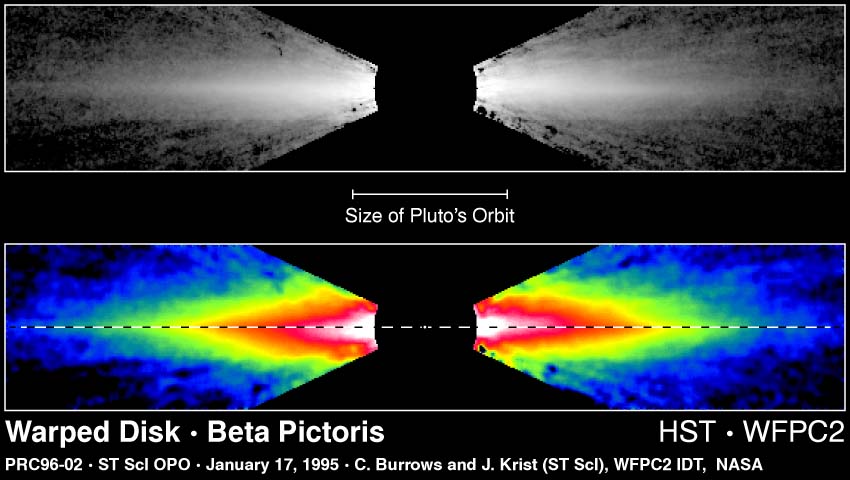
First multicolour images of the disk, and the Hubble discovery of its warp, the first sign of a planet.
- Ground
- ESO 2.2 m, La Silla, with a coronagraph designed with Anatole Evzerov
- Colour result
- Paresce & Burrows 1987, ApJ 319, L23
- Hubble
- WFPC2 Planetary Camera, January 1995; four filters, four roll angles
- Announced
- AAS 187, San Antonio, 17 January 1996
- Planet
- β Pictoris b imaged by Lagrange et al. (VLT), announced 2008, confirmed 2010
The disk around β Pictoris was first imaged by Brad Smith and Richard Terrile in 1984. Chris and Francesco Paresce followed with the first multicolour images, using a coronagraph Chris designed with Anatole Evzerov, a former engineer on the main stellar spectrograph of the Soviet 6-metre BTA telescope, on the ESO 2.2-metre telescope at La Silla. Imaging between 5 and 15 arcseconds from the star in B, V, R and I, they found the disk has the same colour as the star. Interstellar-type dust would scatter blue light preferentially; a neutral colour means the scattering particles are much larger than a micron.
With Pawel Artymowicz they combined the coronagraph images with IRAS far-infrared data in a model where the same grains produce both the scattered light and the thermal emission, constraining the disk's tilt, optical depth, grain size and albedo, and inferring a central void within 10 to 20 AU.
Modelling the disk's scattered light and its absorption of starlight also led Chris to estimate the distance to β Pictoris at about 20 parsecs, rather than the 16 parsecs then commonly used. Hipparcos later measured 19.3 parsecs.
Chris then imaged the disk with Hubble's WFPC2 Planetary Camera in January 1995, as part of the WFPC2 Investigation Definition Team programme, at four roll angles in four filters. The images reached in to about 1.5 arcseconds from the star and showed a relatively clear zone inside 40 AU and, for the first time, a warp in the inner disk: the innermost part orbits in a plane tilted to the rest of the disk. Dynamical simulations showed such a warp would flatten within about a million years, far shorter than the age of the star, so something must be maintaining it. He concluded that at least one massive companion on an inclined orbit was responsible, and estimated it at one-twentieth to twenty Jupiter masses, orbiting within about 1 to 30 AU, inclined about three degrees to the outer disk; at Jupiter's distance it would have about Jupiter's mass.
He presented the result at the American Astronomical Society meeting in San Antonio on 17 January 1996, the same meeting at which Geoff Marcy and Paul Butler announced the planets of 70 Virginis and 47 Ursae Majoris, found by the radial-velocity method a few months after Michel Mayor and Didier Queloz reported 51 Pegasi b. In 1997 Mouillet and colleagues showed quantitatively that a planet on an inclined orbit explains the warp. The planet itself, β Pictoris b, was imaged directly by Anne-Marie Lagrange's team at the VLT, announced in 2008 and confirmed in 2010: a body of roughly nine Jupiter masses about 9 AU from the star, within the range the warp implied.
We were surprised to find that the innermost region of the disk is orbiting in a different plane from the rest of the disk. — Chris Burrows, NASA release, 17 January 1996
Press and media
From the archive
Papers
- 1984
- 1987Broad-band imaging of the Beta Pictoris circumstellar diskParesce, F.; Burrows, C. J.ApJ 319, L23
- 1987Coronography at La Silla: high resolution imaging of faint features near bright objectsParesce, F.; Burrows, C.The Messenger 47, 43
- 1989The structure of the Beta Pictoris circumstellar disk from combined IRAS and coronagraphic observationsArtymowicz, P.; Burrows, C. J.; Paresce, F.ApJ
- 1990The structure of the β Pictoris disk and the properties of its particlesArtymowicz, P.; Paresce, F.; Burrows, C.Advances in Space Research 10, 81
- 1996HST observations of the Beta Pictoris circumstellar diskBurrows, C. J.; Krist, J. E.; Stapelfeldt, K. R.; WFPC2 IDTAAS Meeting 187, abstract 32.05 (San Antonio, January 1996)
- 1997A planet on an inclined orbit as an explanation of the warp in the β Pictoris discMouillet, D.; Larwood, J. D.; Papaloizou, J. C. B.; Lagrange, A.-M.MNRAS 292, 896
- 1997β Pictoris revisited by Hipparcos: star propertiesCrifo, F.; Vidal-Madjar, A.; Lallement, R.; Ferlet, R.; Gerbaldi, M.A&A 320, L29
- 2009A probable giant planet imaged in the β Pictoris diskLagrange, A.-M.; Gratadour, D.; Chauvin, G.; Fusco, T.; et al.A&A 493, L21
- 2010A giant planet imaged in the disk of the young star β PictorisLagrange, A.-M.; Bonnefoy, M.; Chauvin, G.; Apai, D.; et al.Science 329, 57
- 2006