Science with WFPC2 · 1994–2000
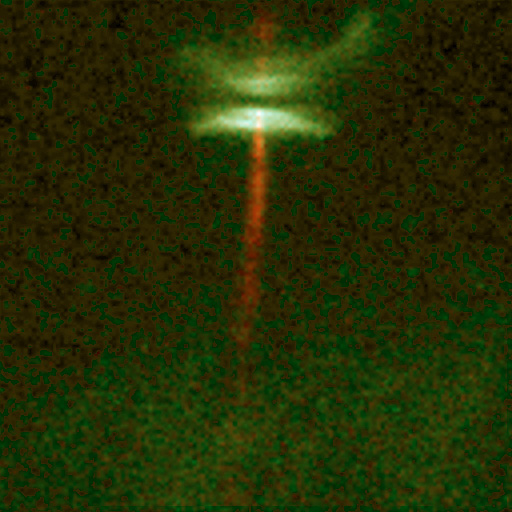
HH 30 disk and jet
The first direct image of a young star's disk and jets together, replacing the textbook sketch.
- Instrument
- WFPC2, from 1994
- Paper
- Burrows et al. 1996, ApJ 473, 437; over 400 citations
- Press
- NASA, 6 June 1995: Hubble observes the fire and fury of a stellar birth
- Follow-up
- Stapelfeldt, Watson, Krist and Burrows on variability, 1999–2007
Accretion disks feeding newborn stars, with jets launched perpendicular to them, had been inferred indirectly and drawn as cartoons. Chris's WFPC2 images of HH 30 in Taurus showed the whole system at once: a flared, nearly edge-on disk lit by its hidden star from above and below, split by a dark dust lane, with narrow bipolar jets emerging along its axis. The picture replaced the cartoon in textbooks as the standard image of a forming star.
The 1996 paper fitted the images with detailed scattered-light models, the same approach he had used to diagnose Hubble's optics, now solving for the physical parameters of the disk. It found a disk of radius about 250 AU inclined less than 10 degrees from edge-on, with a Gaussian height profile showing pressure support, a self-consistent temperature structure, and a mass of about 0.006 solar masses. The extinction to the star exceeds 24 magnitudes. The grains scatter strongly forward but follow the interstellar reddening law.
The jet resolved into knots about 0.4 arcseconds long and apart, moving at 100 to 300 km/s and produced at about 0.4 knots per jet per year, collimated within a 3-degree cone and traceable to within 30 AU of the star. Images taken a year apart showed the knots moving.
The result was released by NASA on 6 June 1995 alongside jets from other young stars imaged by Jeff Hester and Jon Morse. Chris and Karl Stapelfeldt, Alan Watson and John Krist kept monitoring HH 30. In 1999 they reported a variable asymmetry in the disk, and in 2000 NASA released their time-lapse of five years of changes, with light and shadow sweeping across the disk from the region near the star. Since then the system has been studied in the near-infrared, at millimetre wavelengths, with ALMA, and in 2025 with JWST.
For the first time we are seeing a newborn star close up. — Chris Burrows, NASA release, 6 June 1995
Press and media
Papers
- 1996
- 1999
- 2001High-resolution near-infrared images and models of the circumstellar disk in HH 30Cotera, A. S.; Whitney, B. A.; Young, E.; et al.ApJ 556, 958
- 2004The visible and near-infrared dust opacity law in the HH 30 circumstellar diskWatson, A. M.; Stapelfeldt, K. R.ApJ 602, 860
- 2007Asymmetry and variability in the HH 30 circumstellar diskWatson, A. M.; Stapelfeldt, K. R.AJ 133, 845
- 2007Collimation, proper motions, and physical conditions in the HH 30 jet from HST slitless spectroscopyHartigan, P.; Morse, J.ApJ 660, 426
- 2018The HH30 edge-on T Tauri star: a rotating and precessing monopolar outflow scrutinized by ALMALouvet, F.; Dougados, C.; Cabrit, S.; et al.A&A 618, A120
- 2025JWST imaging of edge-on protoplanetary disks IV: mid-infrared dust scattering in the HH 30 diskTazaki, R.; Ménard, F.; Duchêne, G.; et al.ApJ 980, 49