Archive
Historical documents
Original working documents from Chris's files at STScI, transcribed as written, and photographs from the Hubble years.
Original Hubble analysis files, 1990
May–December 1990
The IDL code Chris wrote to diagnose Hubble’s spherical aberration, beginning 22 May 1990, two days after first light, with the exposure logs, image headers, model fits, PostScript figures and working documents from his STScI files. Copied without change, with their original dates.
- Fitting code: SIMPLEX.PRO, FITIT.PRO, CONVERT.PRO, PS.PRO, CRVEFIT.PRO, FUN.PRO, GETPSF.PRO, OTA.PRO
Hubble Performance Monitoring and Assessment meeting #5, Goddard: minutes (excerpt)
5 June 1990 (file dated 11 June 1990)
Official minutes of the weekly HST performance meeting at Goddard, from Chris’s STScI files. Six days after Chris’s 30 May memorandum giving about half a wave rms of spherical aberration, the optics contractor (Hughes Danbury) reported its own phase-retrieval result from a 3 June image: spherical only ~0.2 wave peak-to-valley, with ~4 waves of coma attributed to secondary-mirror misalignment. The same minutes schedule the joint SWG/Users Committee/PMA meeting of 27 June at which Chris presented the diagnosis. Excerpt; attendee contact details omitted.
PERFORMANCE MONITORING AND ASSESSMENT WEEKLY MEETING #5 Tuesday June 5, 1990, 1:30 - 3:30 p.m. Goddard Space Flight Center, Building 8, 3rd Floor Management Conference Center N303
[Excerpt from the minutes as circulated by e-mail, file dated 11 June 1990. Only the OTA/wavefront items and the meeting schedule are reproduced; attendee contact details omitted.]
PMA Status - Keith Kalinowski
... The first monthly PMA meeting will be a joint SWG/HST Users Committee/PMA monthly to be held June 27 in Building 22 Room 365. ...
Executive Summary (extract)
Bob Basedow reported on the current OTA status. He presented results of analysis on the FGS's, the Optical Control System/Wavefront Sensors and the Thermal system. ... The Image size is ~ 0.7 arcsecs and the wavefront is estimated at: Focus ~ 2 waves, astigmatism ~.2 waves, coma ~ 4 waves, and spherical is ~ .2 waves. There are currently no significant thermal anomalies.
OTA STATUS - Bob Basedow, HDOS
OCS/WAVEFRONT Status
o Focus currently best achievable using FGSs (Bootstrap Phase A) o FGS data indicates image size ~0.7 asecs o WFPC data consistent with this, but shows central 0.15 asec core o HDOS Phase retrieval algorithm applied to PC image of 6/3/90 o Wavefront estimated at: FOCUS ~ 2 WAVES o-p ASTIGMATISM ~0.2 WAVES o-p COMA ~4 WAVES o-p SPHERICAL ~0.2 WAVES o-p o Estimate probably significantly affected by WFPC optics, especially central obscuration alignment
The phase retrieval model does not account for the WFPC optics, and therefore cannot reproduce the PSF's. Nutuation of the annulus around the peak of the PSF, is attributed to the mis-alignment of the secondary mirror.
OBA is a package which finds the aberrations given a PSF Measured PSF's are taken from the WF/PC Have Fit "1st Light" WFC PSF and a PC PSF
Ongoing Analysis: Find cause of skirt around PSF (pupil vignette) Field Dependence in WF/PC CCD arrays Further algorithm refinement
WFPC REPORT There was no one available to report on the status of the WFPC.
Disk around star may be warped by unseen planet: press release draft
Revision of 9 January 1996 (created 6 December 1995)
Chris's working draft of the NASA/STScI release announcing the β Pictoris warp at the AAS meeting in San Antonio, with the science backgrounder and photo caption. Typos corrected; otherwise as written.
DISK AROUND STAR MAY BE WARPED BY UNSEEN PLANET
NASA's Hubble Space Telescope has provided strong evidence for the existence of a Jupiter-sized planet orbiting the star Beta Pictoris.
Detailed Hubble images of the inner region of the 200-billion mile diameter dust disk encircling the star reveal an unexpected warp. Researchers say the warp can be best explained as caused by the gravitational pull of an unseen planet.
The suspected planet would dwell within a five billion mile wide clear zone in the center of the disk. This zone has long been suspected of harboring planets that swept it clear of debris, but the Hubble discovery provides more definitive evidence that a planet is there. (Alternative theories suggest the clear zone is empty because it is too warm for ice particles to exist).
"We were surprised to find that the innermost region of the disk is orbiting in a different plane from the rest of the disk," says Chris Burrows (Space Telescope Science Institute, Baltimore MD, and the European Space Agency) who is presenting his results at the meeting of the American Astronomical Society in San Antonio Texas.
As he analyzed Hubble images, taken in January 1995 with the Wide Field Planetary Camera 2, Burrows discovered an unusual bulge in the nearly edge-on disk, which was mirrored on the other side of the star. "Such a warp cannot last for very long," says Burrows. "This means that something is still twisting the disk and keeping out of a basic flat shape."
"The presence of the warp is strong though indirect evidence for the existence of planets in this system. If Beta Pictoris had a solar system like ours, it would produce a warp like the one we see." Burrows concludes, "The Beta Pictoris system seems to contain at least one planet not too dissimilar from Jupiter in size and orbit. Rocky planets like Earth might circle Beta Pictoris as well. However, there is no direct evidence for these yet. Any planet will be at least a billion-times fainter than the star, and presently impossible to view directly, even with Hubble."
An alterative explanation is that the disk could have been perturbed by a passing star, but this is very unlikely because only the inner region of the disk is affected. Burrows estimates that there is a one in 400,000 chance for such a close encounter for Beta Pictoris. "Other explanations for the warp do not allow it to last for very long, but the central star is probably at least 100 million years old."
The size of the warp allows Burrows to roughly measure the mass of the orbiting body. "It must lie well within the warp, probably within the clear zone that exists around Beta Pictoris." On the other hand, he points out, it cannot be too close to the star because its gravitational pull would cause the star to "jiggle," and such radial velocity variations have never been seen in Beta Pictoris.
Burrows estimates the planet is from one-twentieth to twenty times the mass of Jupiter. The planet must lie within the range of distances typical of planetary distances within our solar system -- from about Earth's distance from the Sun to about 30 times Earth's distance (distance from the Sun to Pluto).
If the suspected planet were as far from Beta Pictoris as Jupiter is from our Sun it would also have about the same mass as Jupiter. The planet's orbit must be inclined about three degrees to the plane of the Beta Pictoris disk, and this is typical of the inclinations of the orbits of the planets in our solar system.
The star is located 50 light-years away in the southern constellation Pictor (Painter's Easel). Though it precise age is not known Beta Pictoris is generally considered a mature, "main sequence" star, slightly hotter than our Sun.
Detections of substellar objects orbiting nearby stars have recently been reported for two other normal (i.e., main-sequence) stars -- Gliese 229 and 51 Pegasus. However, Beta Pictoris is the only candidate that looks like it might possess a planetary system similar to our own.
Beta Pictoris is also the only known star with a circumstellar disk of gas and dust that can be optically imaged. Despite the presence of dust, deduced from IRAS (NASA Infrared Astronomy Satellite) data, around approximately one-third of the brightest nearby stars, ground-based telescope imaging has not detected other candidate disks.
Several Hubble programs are currently in progress to search for these disks. NICMOS (Near Infrared Camera and Multi-Object Spectrometer), to be installed on Hubble during the February 1997 servicing mission, will provide a near-infrared capability for this type of search.
SCIENCE BACKGROUNDER: THE DYNAMICS OF THE BETA PICTORIS DISK
Why hasn't the warp been detected previously? Though the Beta Pictoris disk has been studied intensively for more than a decade the inner region of the disk is very hard to see with ground-based telescopes because of the glare from the central star. Also, the visible disk is faint because it consists of microscopic grains of ice and dust that shine only by reflecting light from the star. Hubble Space Telescope concentrates the star's light and produces an image that is ten times sharper than can be obtained from the ground under good conditions.
How is the lifetime of the warp determined? Because the microscopic dust particles in the disk collide, in about a million years they either fall into the star or get broken up and blown out of the system by radiation pressure. Any warp in the visible disk will straighten out in even less time because of the same viscous processes. This means some continuous source of both particles and the warp must be in operation. The particles are probably the result of collisions within a belt of unseen larger comet-like objects which are tens of kilometers in diameter (like in the Kuiper belt around our own solar system). In the absence of a planetary perturbation a warp in this "Kuiper belt" region would straighten out by gravity within less than ten million years.
How exactly does a planet warp the disk? In 100 million years a Jupiter sized planet in a Jupiter sized orbit would produce and maintain the warp Hubble sees. The Hubble results predict the planet's orbital plane is inclined by about three degrees to the outer disk. The comet-like bodies within the warped area precess, or wobble, around the planet's orbital plane and this leads to the inner disk being fattened and aligned with the planet's orbit. Material outside of that radius has not had time for its orbit to precess significantly, so appears in its original plane.
Why is there a central clear area in the Beta Pictoris disk? The central clear area, approximately the diameter of our Solar System, has long been suspected of harboring one or more planets which coalesced out of the disk. After planets form, they are expected to rapidly clear the visible disk in their vicinity. However, an alternative explanation was that the clear zone is the result of ice sublimation.
PHOTO CAPTION: WARPED DISK MAY INDICATE PRESENCE OF PLANET AROUND THE STAR BETA PICTORIS
This image from NASA's Hubble Space Telescope shows for the first time the inner region of a 200 billion-mile diameter dust disk around the star Beta Pictoris. This region has long been hidden from ground-based telescopes because of the glare of the central star. The disk is slightly warped. If the warp were there when the star formed, it would have long since have flattened out, unless it is produced and maintained by the gravitational pull of a planet perturbing it. The suspected planet would dwell inside a five billion-mile diameter clear zone inside the inner edge of the disk.
Top: a visible light image of the disk, which appears spindle-like because it is tilted nearly edge-on to our view. The bright star, which lies at the center of the disk, is blocked out in this image. Bottom: false-color is applied through image processing to accentuate details in the disk structure. Hubble reveals that the pink-white inner edge of the disk is slightly tilted from the plane of the outer disk (red-yellow-green) as identified by a dotted line.
This image was taken with the Wide Field Planetary Camera-2 in January 1995. Credit: Chris Burrows, Space Telescope Science Institute, the European Space Agency (ESA), the WFPC2 IDT team and NASA.
The Advanced Camera Coronagraph for HST
c. 1996–98 (ACS then due for installation in 1999)
Abstract by C. J. Burrows (STScI and ESA Astrophysics Division) describing the aberrated-beam coronagraph later flown in the ACS High Resolution Channel.
The Advanced Camera for Surveys is due to be installed in an axial bay on HST in 1999. It will be a substantial improvement over WFPC2 in field of view, resolution, quantum efficiency, and read noise. WFPC2 has no high contrast channel, and in fact suffers from very high levels of instrumentally scattered light. Only limited coronagraphic channels are available for STIS and NICMOS. The new coronagraphic mode on the Advanced camera will therefore represent our first chance to fully exploit the high dynamic range potential of HST. The coronagraph operates by inserting a field stop into the aberrated beam at the circle of least confusion. Light diffracted around this obstacle is caught by a pupil plane Lyot stop. The residual scattered light level is set by mid-scale ripple on the HST mirror surfaces. We will show details of the projected performance of this new capability.
The coronagraph will not be able to directly detect planets orbiting nearby stars, except in the most optimistic case. However, it will have a broad range of other potential astrophysical applications. In particular, it will be able to clearly image the initial conditions for planetary systems (protostellar disks - particularly when oriented with their pole pointing towards us) and their remnant byproducts (circumstellar disks). Main sequence disks can be perturbed by the presence of planets, as illustrated by HST observations of Beta Pictoris. A range of existing WFPC2 observations of such systems will be shown to illustrate the current limits of our observations. Better circumstellar disk observations are a necessary prerequisite to more refined and targeted searches for other planetary systems. This applies to the proposed nulling infrared interferometer, where asymmetries in the circumstellar material distribution might mimic the signal from a planet. On the other hand, asymmetries in a disk can also indicate the presence of planets.
HST Coronagraph
c. 1995–96 (written for a servicing mission then scheduled for 2003)
Design note for a dedicated Hubble coronagraph with wavefront correction. Its elements carried into Codex: about 40 actuators across the pupil, a 0.5″ graded Gaussian focal-plane mask, and a 1/100 contrast detection criterion.
Indirect techniques hold the greatest promise for the first detection of extra-solar planets. However, if Jupiter sized planets are common, the first direct detection could come from HST. Unfortunately, HST with its present and planned instrumental complement is not able to detect extra-solar planets because of the high levels of scattered light in the image wings around a star. Techniques for the suppression of this light exist, and can be expected to give HST the capability to directly image Jupiter sized planets out to a distance of about 5 parsec. Such an instrument, could be flown in the scheduled HST servicing mission in 2003.
If such an instrument is flown, several of its other scientific applications have also long been specifically identified as high priority endeavors. Furthermore, several of these applications also bear directly on our desire to understand and characterize the formation and evolution of planetary systems. In particular, in addition to allowing extra-solar planet detection, and some limited spectral investigation, the coronagraph will let us study star formation and proto-planetary disks and search for sub-stellar brown dwarf companion stars. All of these studies are presently limited by the achievable contrast in both HST and ground based telescopes.
HST with a coronagraph would combine the high spatial resolution essential to achieving sufficient signal to noise on the planet, with low scattered light levels. In principle a system with active optics on the ground might achieve such a combination, however, we feel that the space based option is much easier to implement because the temporal bandwidth of the active optics control system is five orders of magnitude lower, and the stroke required is some two orders of magnitude smaller. In addition scintillation (time dependent amplitude variations) noise is absent in space. The correction of scintillation noise from the ground is yet to be demonstrated.
The HST coronagraph would reduce or eliminate background light from the central source by a variety of techniques. In the visible on HST we are presently limited by detector defects, filter ghosts, diffraction and mirror polishing defects. All of these problems can be greatly reduced or eliminated in a design that concentrates on them. The elements of a workable design are clear. Detector problems, and filter ghosts would be eliminated as problems by ensuring that the light from the bright central source is largely eliminated before reaching the filters or detector.
Light would enter the instrument after reflecting from the HST primary and secondary mirrors, possibly after an additional reflection from a super-smooth and clean pick-off mirror. The pick-off mirror is necessary if a radial instrument (to replace the present Wide Field Planetary Camera) is chosen. The beam would be corrected for HST's spherical aberration, possible off axis astigmatism, and for time dependent pointing and focus variations.
The HST is known to suffer from pointing variations at the level of 5 milli-arcseconds rms, with a dominant period of 12 seconds, and focus changes with a peak to peak amplitude of 1/20 wave and a period of 95 minutes. Low spatial frequency and low temporal bandwidth wave-front sensing is therefore necessary, with the bright central star providing an ideal phase reference. Electro-strictive actuators similar to those flown on WFPC2 can be used to steer the corrected beam. If placed on a mirror with sufficient optical power, they will also provide sufficient stroke for focus correction (about 5 microns throw at a magnification of 10 is needed). In addition, a higher frequency fixed correction would be applied to correct for the fixed pattern of phase errors introduced by the primary and secondary mirrors. This correction would only need to work at the field position of the central star, and would need to have approximately 40 actuators across the pupil diameter, in order to suppress the scattered light due to mirror imperfections within the central arcsecond or so.
With this optical correction in place, the unattenuated image reaching the first focal plane would be very close to diffraction limited, and a coronagraph can then further reduce the wing intensity by factors of up to 1000. We have modeled this system in detail with the measured phase errors that are present on the HST being corrected at various levels of accuracy. A graded Gaussian focal plane mask with a width of 0.5 arcseconds was used. The pupil plane mask used in the simulations was not graded, and no doubt performance improvements in the coronagraph would be possible if it were. One immediate conclusion from this modeling is that one is always limited in practice by residual wave-front errors. For any level of pupil correction, it is possible to design a coronagraph to take advantage of it.
The filter wheel would be positioned after this camera. It would contain both broad band filters (for sensitivity and wavelength coverage) and narrow band filters (for searches for point or extended sources "between the airy rings" at still higher contrast). It should also contain a number of zero focal shift polarizing filters both for circumstellar scattering studies, and for additional suppression of instrumental scattered light. A selection of polarizers which are anti- reflection coated to match the various visible filters would be ideal. The double bounce ghost which arises between the filter pairs can be moved to one side of the central peak by tilting the polarizer wheel axis by a few degrees. Then spacecraft roll can be used to cover the region of lower contrast
The detector should be backside illuminated to eliminate scatter from front-side electrode structures. It should have a blackened spot deposited over the central 0.2 arcsecond region covered by the central bright object. This will eliminate scatter and bleeding effects caused by the brightest part of the residual stellar image. The detector itself should be tilted to shift detector-filter ghosts to one side. (this can be done in the slow beams we need for adequate image sampling without significant focus errors) The single detector should critically sample the beam at blue wavelengths, which makes resampling (for small image shifts in data reduction) a mathematical possibility. It is very important to control Charge Transfer Efficiency in the detector. This can be done at least partially by operating at very low temperatures (<100C), and by selecting devices made with very pure silicone - eliminating a population of traps (CTE is the major source of contrast loss for WFPC2 beyond about 5 arcseconds from the image core). Condensation on the detector might be eliminated by fitting a warm window below the filter wheel but is not expected to be a major problem at visible wavelengths. We would rather operate the detector without a window if this is technically possible.
There are two requirements that must be met if a planet is to be detected. First, the ratio of its brightness to the residual star light at its location in the image must be big enough. A point-like source of 1/10 the local wing intensity in a broad-band image is easy to detect for example by rolling the spacecraft and comparing the images, or by local profile fitting. Conversely, a source with a signal only 1/1000 of the average wing intensity is in practice very hard to detect, because it is unlikely that the instrument response will be stable at this level. We feel that a contrast of 1/100 represents a reasonable detectability threshold.
The second requirement for detectability is that imposed by photon statistics. The signal in an Airy disk from the background must fluctuate much less in the integration time used than the signal from the planet. Clearly, a reasonable requirement is that the survey of candidate stars which have sufficient contrast from the first criterion, be completed in a year. It turns out that this is not a problem, given that the first criterion limits one to about 30 candidates, and the integration time needed for a zeroth magnitude star at 5 parsecs would be about 40 minutes for a signal to noise of 5. Note that the signal to noise goes as the star brightness (not the square root), because the background decreases as the signal gets weaker.
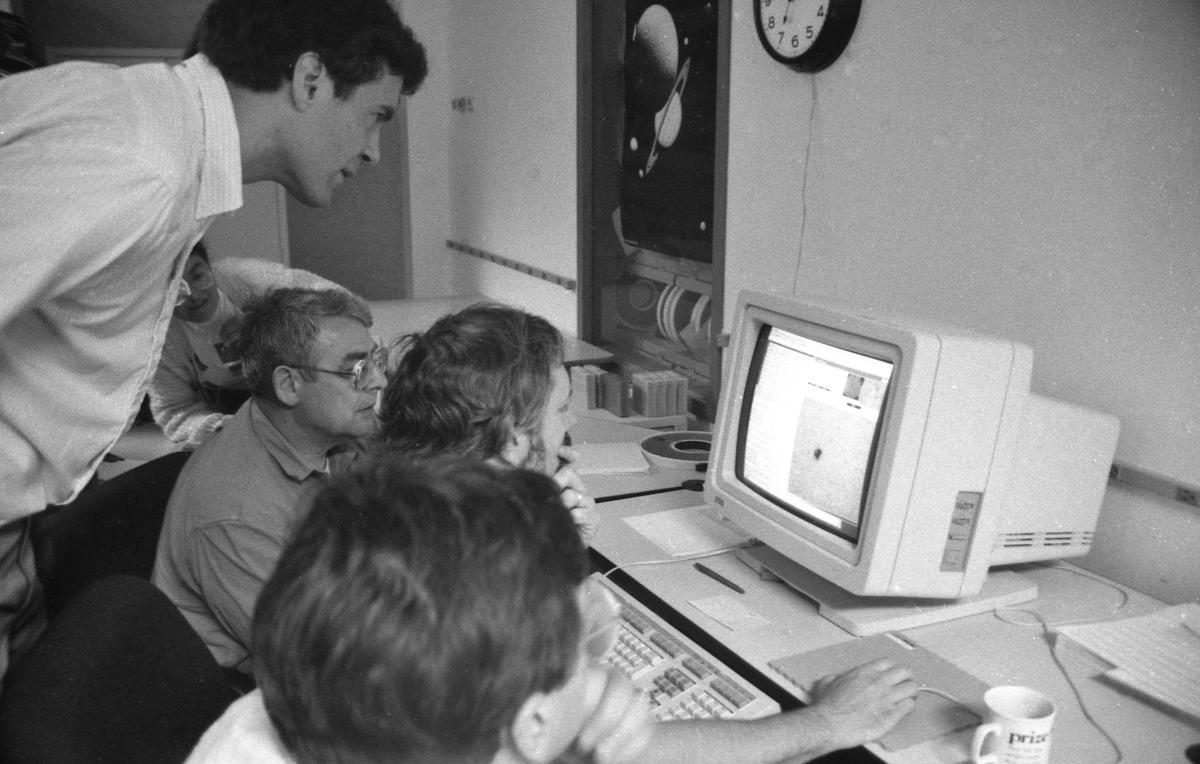
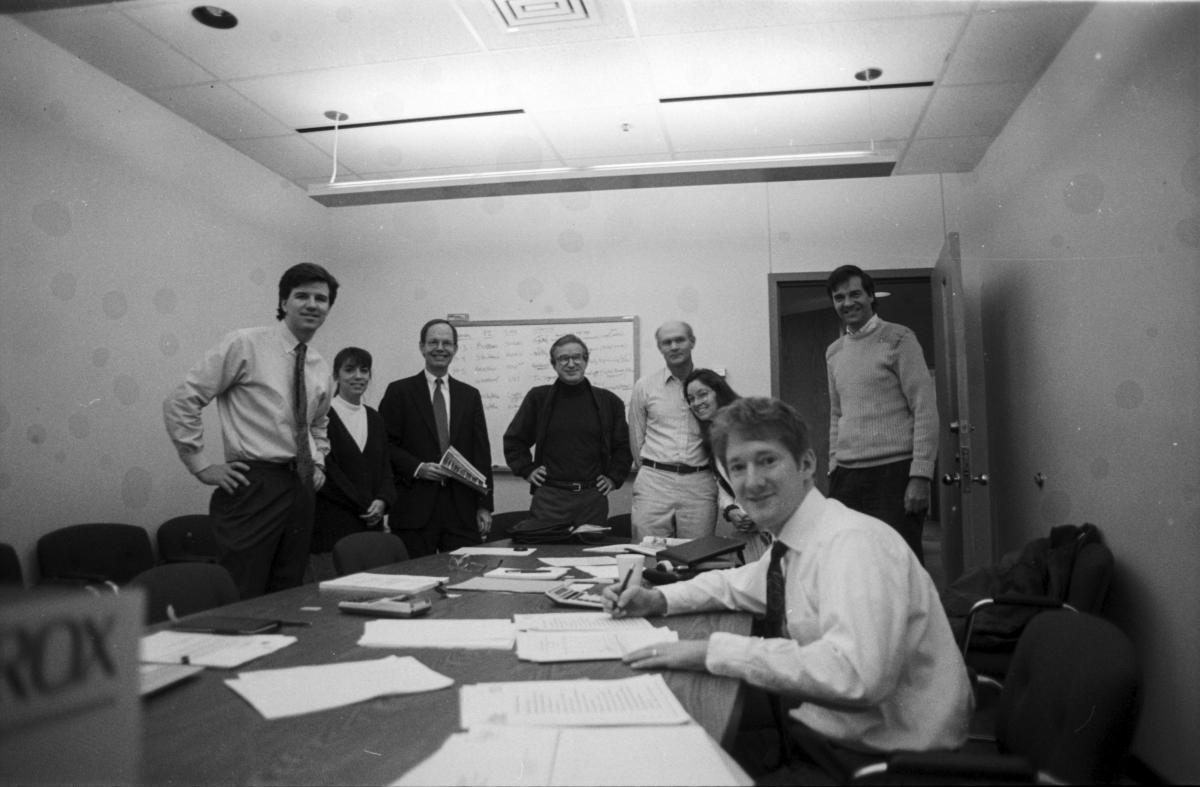
Photographs, 1987–91
Photographs by Pierre Bely, taken at the Space Telescope Science Institute in the years around Hubble's launch.