Hubble Space Telescope · 1990
Diagnosing Hubble's spherical aberration
First to fit Hubble's first-light image with phase retrieval and find half a wave of spherical aberration.
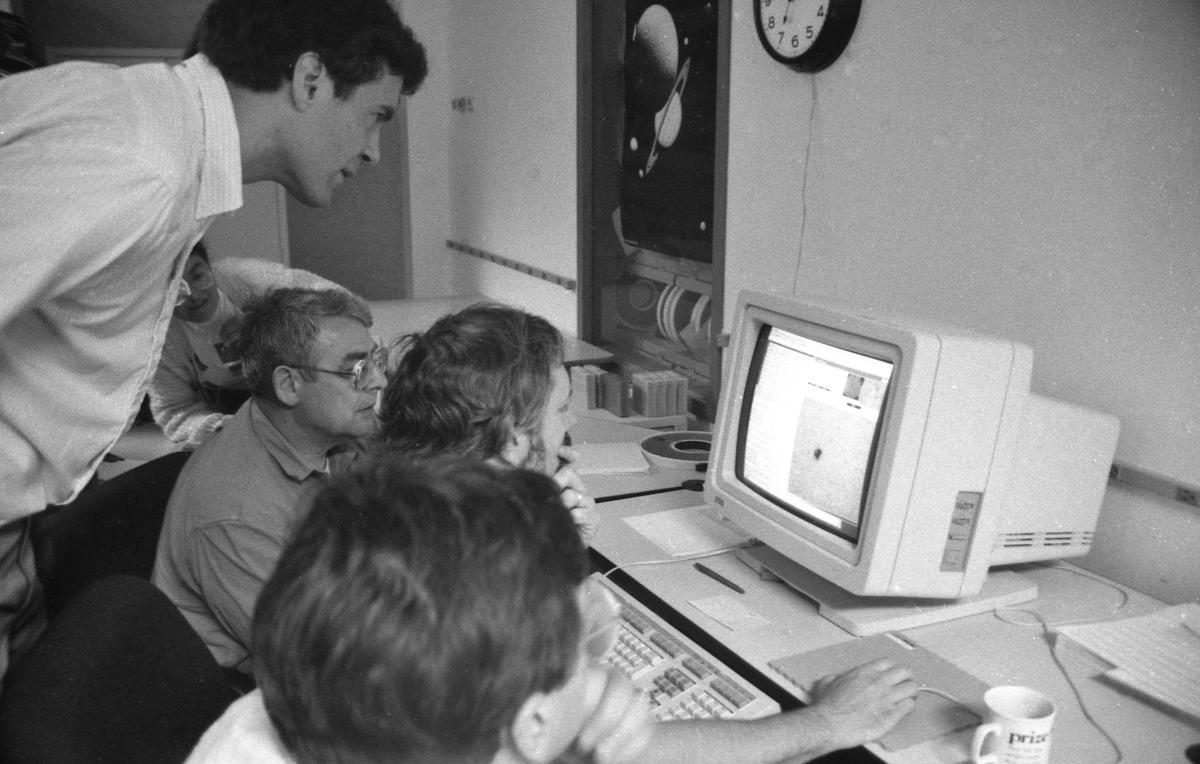
- Method
- Phase retrieval: least-squares fit of a Fourier-optics model of the telescope to star images
- Result
- About 0.5 wave rms of spherical aberration, confirmed by every later analysis
- Recognition
- NASA Public Service Medal, 1992
- Oral history
- Interviewed by Chris Gainor, 15 February 2017, HST Operational History Project
- Browse all 159 original files · Download everything (zip, 5 MB)
- Key programs: SIMPLEX.PRO (22 May), FITIT.PRO (25 May), CONVERT.PRO (30 May, spherical term), PS.PRO (31 May, fitted coefficients), OTA.PRO (6 June, telescope model)
- Logs and documents: IMAGES.LOG (June focus runs), STScI Newsletter, July 1990, Strategy Panel input, October 1990
Before launch Chris had written the Optical Telescope Assembly Handbook and, with Hashima Hasan, the Telescope Image Model: an end-to-end simulator built on optical prescriptions of every instrument, including diffraction, dust and mirror microroughness. That preparation is why he could read the first images when nobody else could.
The first-light image was expected to show a misaligned secondary mirror. Chris wrote a new fitting procedure in IDL that solved for the aberrations directly from the brightest star in the field, including spherical aberration only for completeness. Within about a day the fit converged on roughly half a wave of it. The next day he arrived at a Goddard meeting where Jim Westphal was presenting the image and told the room he understood it, with simulations that reproduced what the telescope was seeing. Adding the secondary-mirror spiders to the model then explained the image's puzzling tendrils.
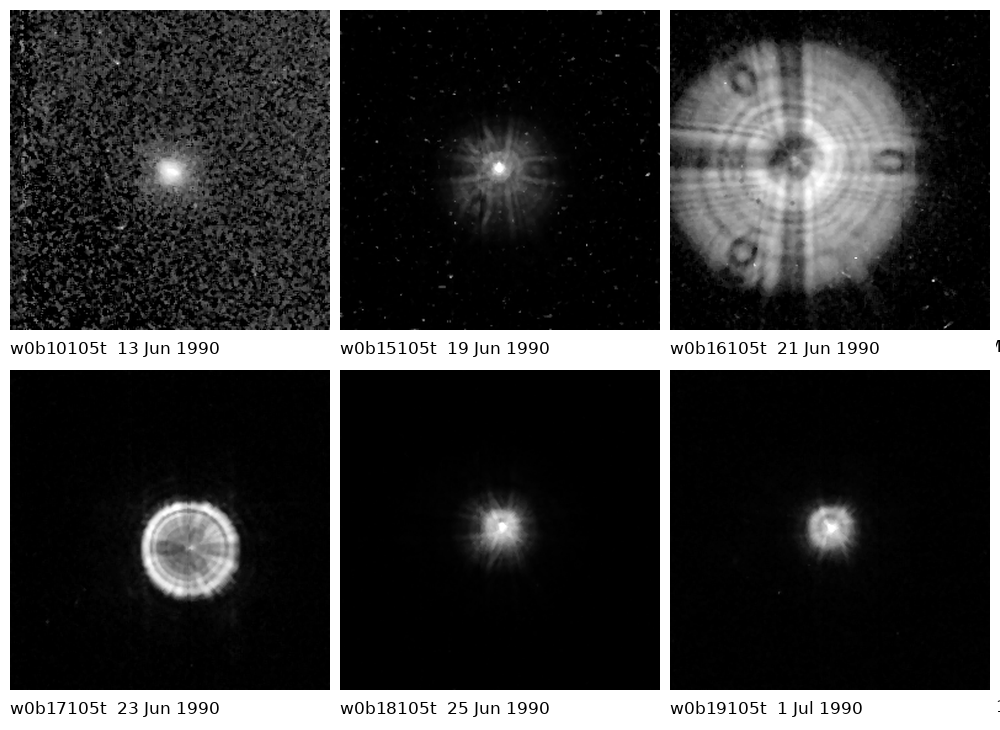
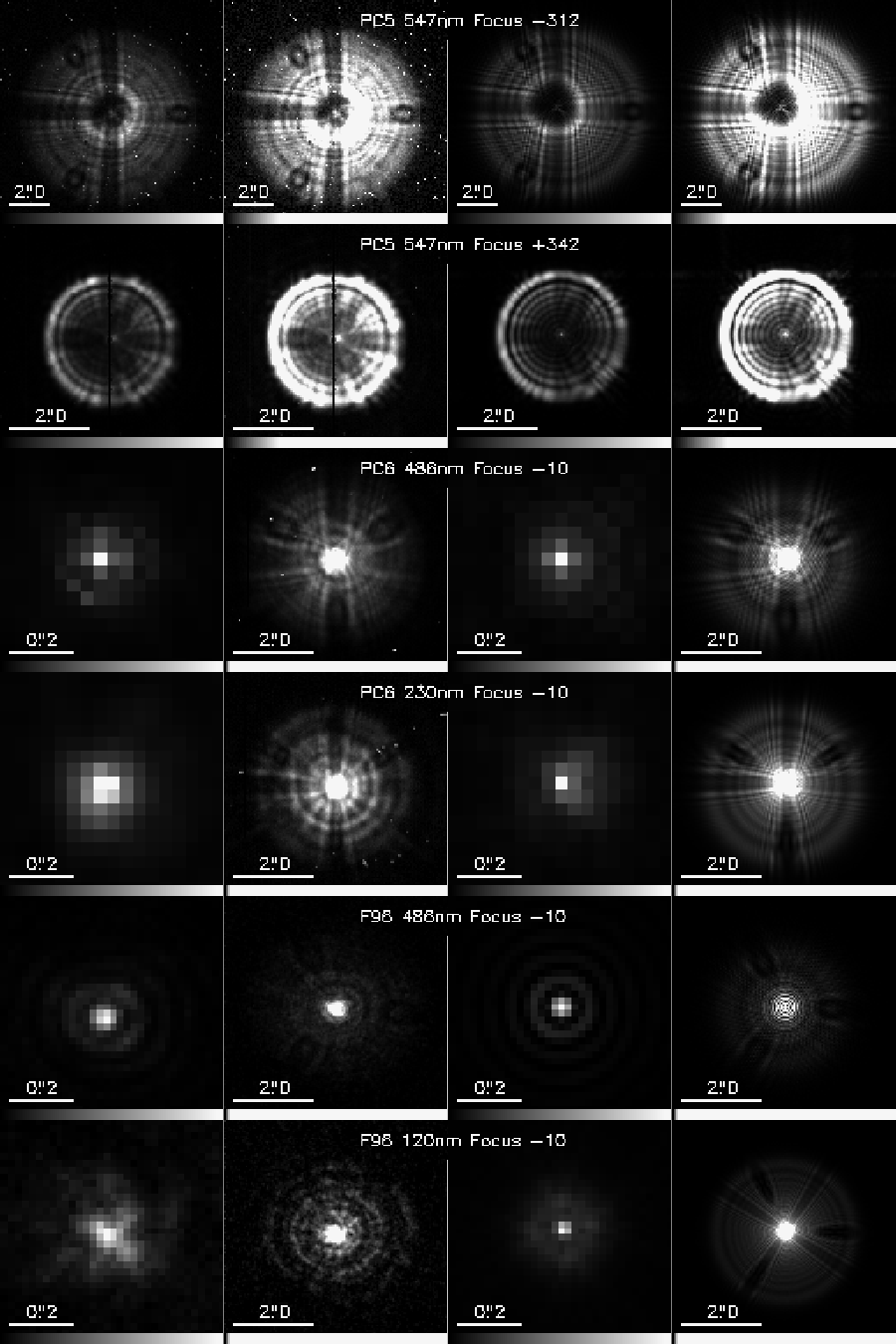
For about a month the result was resisted, in particular by the contractor, whose own fits had found nothing wrong. The turning point was a meeting at which Bob Basedow said that if Chris was right, the primary-mirror actuators were a factor of seven too weak to correct it. That was when he knew the problem could not be fixed in orbit. The project ordered silence while out-of-focus images that Chris had planned were taken; they showed the through-focus behaviour of spherical aberration. Jon Holtzman independently confirmed the result by running Chris’s Telescope Image Model, which simulates images but does not fit them, to simulate the out-of-focus images with Chris’s aberration values; the simulations closely matched the observed out-of-focus images, showing the error was smooth. Robert Brown, in his NASA oral history, recalls Chris as “the first person to know that it was a spherical aberration problem”.
Chris then presented to the Science Working Group and sat on the technical panel at NASA's announcement. Faint Object Camera images, far enough off axis that a secondary-mirror error would have shown as coma, placed the fault on the primary. He served on the HST Strategy Panel that chose the recovery path, and on the HARP panel that pinned down the prescription from flight images and the “fossil” ground-test data; it came back to the half wave he had first announced. He then used the same software to verify, on the bench, that the WFPC2 relay optics and the COSTAR mirrors carried exactly the opposite error.
In recognition of your achievements in understanding and characterizing the optical performance of the Hubble Space Telescope. — NASA Public Service Medal citation, 1992
Timeline
- 1984, 1 AprilArrives at STScI as one of ESA's fifteen staff; joins the Research Support Branch with Pete Stockman, Jim Crocker and Pierre Bely.
- 1984–89Writes the OTA Handbook and, with Hashima Hasan, builds the Telescope Image Model (TIM).
- 1990, 24–25 AprilHubble launched and deployed. The optical control system's wavefront sensors fail to give usable fringes, later understood to be because of the aberration.
- 1990, 20 MayFirst-light image with the Wide Field/Planetary Camera. Chris identifies the field from a star catalogue and starts fitting the star images.
- 1990, 22–25 MayDated IDL fitting code in Chris’s STScI files: simplex optimiser (22 May) and PSF-fitting driver (25 May).
- Within about a dayIDL phase-retrieval fit finds about half a wave of spherical aberration.
- Next dayInterrupts a Goddard meeting where Jim Westphal is presenting the image: “I understand this image.”
- Following weeksSecond- and third-light images refine the model; spider obscurations explain the tendrils. Frank Cepollina has a VAX and a viewgraph printer delivered to his office. Two-day loops: design an observation, take it, fit it, present it.
- 1990, 30 MayNineteen-page memorandum making the quantitative case for spherical aberration from a “symmetrically deviant circular mirror”, addressed to Rodger Doxsey and Chris Blades; shown to Eric Chaisson ten days after first light and then sent to NASA (Chaisson, The Hubble Wars, pp. 190–191).
- 1990, 5 JuneAt the weekly performance meeting at Goddard, Hughes Danbury reports its phase retrieval of a 3 June image: spherical ~0.2 wave, coma ~4 waves, attributed to secondary-mirror misalignment (meeting minutes, in the Archive; also quoted by Chaisson, p. 192).
- About a monthContractor (Hughes Danbury Optical Systems) disputes the result.
- June 1990Key meeting with John Campbell, Bob Basedow, Jean Olivier, Jim Westphal, Sandra Faber, Jon Holtzman: actuators a factor of seven short. Instructed to keep quiet.
- June 1990Iota Carinae test images: Chris’s simulations reproduce the observed images (Chaisson, p. 194). By 22 June the Institute’s position, based on his simulations, is that the primary mirror is the likely culprit (p. 196).
- 1990, 21 and 23 JuneOut-of-focus Planetary Camera exposures of a star near Iota Carinae, with the secondary mirror moved 312 µm toward the primary and then the maximum distance away (exposure log IMAGES.LOG in the original files).
- June 1990Out-of-focus images planned by Chris confirm spherical aberration. Jon Holtzman runs Chris’s Telescope Image Model (a simulator, not a fitting code) with the half-wave value to simulate the out-of-focus images, and independently reproduces them. The phase-retrieval analysis is documented in Krist & Burrows, Applied Optics 34, 4951 (1995).
- June 1990Warns STScI news director Ray Villard the day before the announcement.
- 1990, 27 JuneChris presents the diagnosis to the HST Science Working Group, then sits on the second, technical panel at the NASA press conference that announces the flaw in the primary mirror to the world.
- Summer 1990Faint Object Camera first light shows no coma: the error is on the primary. Visits HDOS with John Wood; the backup primary is uncrated.
- 1990, JulyWrites the STScI Newsletter assessment of imaging performance: “approximately 0.5 wavelengths RMS of spherical aberration” (NEWSLETTER.TEX, 27 July 1990, in the original files).
- 1990, Aug–OctHST Strategy Panel, chaired by Robert Brown and Holland Ford, including a meeting at ESO in Garching. Chris argues for a full-aperture corrector; COSTAR is chosen.
- 1990–91HARP panel reconciles flight and ground data; prescription confirms half a wave rms.
- 1991, 10 MarchBurrows et al., The imaging performance of the Hubble Space Telescope, ApJ 369, L21.
- 1991–93Verifies WFPC2 relays and COSTAR mirrors on the bench. Weeks before shipping, resolves a false out-of-focus result in Goddard's WFPC2 test.
- 1993, DecemberServicing Mission 1 installs WFPC2 and COSTAR; Chris aligns WFPC2's pupil on the 30 Doradus field, chosen so alignment images would also yield science.
- 1994, JanuaryPresents WFPC2 first-light images to the AAS: “we got the sign right.”
Original figures, 1990


Original files, 1990
Copied without change from Chris’s STScI VAX directories (later archived to his own files), with their original dates. IDL code (.PRO), GEIS image headers (.HHH, .D0H) and data (.HHD, VAX floating point), logs and PostScript. The original exposures are public in the MAST archive; the last two groups below link the calibrated and the raw files directly. The 1990 analysis began on raw data that Chris and Glenn Schneider took directly, bypassing the routine ground system to save time (the B suffix in the 1990 local file names corresponds to the archive’s T suffix).
Fitting code, May–August 1990 (39 files)
- 1990-05-22
OLDFIT/SIMPLEX.PRO2,079 bytes — Simplex optimiser (header: written 26 Jan 1988) - 1990-05-25
FIT/FITIT.PRO779 bytes - 1990-05-25
OLDFIT/FITIT.PRO743 bytes — Interactive PSF model from annular pupil with focus, coma, astigmatism - 1990-05-25
OLDFIT/FUNSPX.PRO61 bytes — Merit-function hook for the simplex fit - 1990-05-30
OLDFIT/CONVERT.PRO877 bytes — Converts fitted polynomial coefficients to normalised aberrations, including spherical - 1990-05-31
OLDFIT/PS.PRO757 bytes — Plots fitted cases; holds the fitted coefficient sets - 1990-06-06
OTA.CAT1,372 bytes - 1990-06-06
OTA.PRO17,492 bytes — OTA model program - 1990-06-07
WFPC.DIS125 bytes - 1990-06-14
FIT/FOV.PRO1,031 bytes - 1990-06-14
OLDFIT/CURVEFIT.PRO3,745 bytes — Least-squares fitting driver - 1990-06-14
OLDFIT/FOV.PRO987 bytes - 1990-06-15
OLDFIT/PSPRINT.PRO156 bytes - 1990-06-22
OLDFIT/TFUN.PRO1,045 bytes — Test driver for the PSF model with spherical-aberration term - 1990-06-25
OLDFIT/CRVEFIT.PRO7,996 bytes — Modified least-squares fitter - 1990-06-25
OLDFIT/FUNCT.PRO682 bytes — Numerical derivatives for the fit - 1990-07-04
FIT/FGS.PRO1,245 bytes - 1990-07-04
FIT/OTA.PRO1,794 bytes - 1990-07-04
OLDFIT/FGS.PRO1,205 bytes - 1990-07-04
OLDFIT/OTA.PRO1,736 bytes - 1990-07-05
FIT/FOC.PRO1,351 bytes - 1990-07-05
OLDFIT/FOC.PRO1,312 bytes - 1990-07-06
FIT/PIERRE.PRO2,924 bytes - 1990-07-06
FIT/SCURVE.PRO2,206 bytes - 1990-07-06
OLDFIT/PIERRE.PRO2,832 bytes - 1990-07-06
OLDFIT/SCURVE.PRO2,132 bytes - 1990-07-10
OLDFIT/FOCALL.PRO1,131 bytes - 1990-07-13
FIT/WEILER.PRO803 bytes - 1990-07-13
OLDFIT/WEILER.PRO776 bytes - 1990-07-16
OLDFIT/ENCIRC.PRO589 bytes - 1990-07-19
FIT/SKY.PRO1,082 bytes - 1990-07-19
OLDFIT/SKY.PRO1,041 bytes - 1990-08-14
OLDFIT/FITB.PRO3,059 bytes — Fitting driver (August 1990) - 1990-08-14
OLDFIT/FUN.PRO7,438 bytes — PSF model function (August 1990 version) - 1990-08-14
OLDFIT/GETPSF.PRO5,636 bytes — Extracts star images for fitting - 1990-08-14
OLDFIT/PRINTA.PRO3,642 bytes - 1990-08-14
OLDFIT/SCALE.PRO565 bytes - 1990-08-14
OLDFIT/SETA.PRO3,805 bytes — Starting values for the aberration fit - 1990-08-14
OLDFIT/TEST.PRO618 bytes
Images, headers and logs, June–December 1990 (115 files)
- 1990-06-22
IMG/W0B16105B.D0H6,075 bytes — Header: PC F547M, 180 s, 21 June 1990, secondary −312 µm (out of focus) - 1990-06-24
IMG/W0B17105B.D0H6,075 bytes — Header: PC F547M, 180 s, 23 June 1990, secondary +342 µm (out of focus) - 1990-08-16
IMG/W0BM0605B.D0H6,075 bytes - 1990-09-19
IMG/IMAGES.LOG3,984 bytes — Log of the WF/PC focus exposures of 21 and 23 June 1990 (secondary moved −312 and +342 µm) and later runs - 1990-10-11
IMG/PC6F230W.HHD131,072 bytes - 1990-10-11
IMG/PC6F230W.HHH4,455 bytes - 1990-10-11
IMG/PC6F487N.HHD131,072 bytes - 1990-10-11
IMG/PC6F487N.HHH4,455 bytes - 1990-10-11
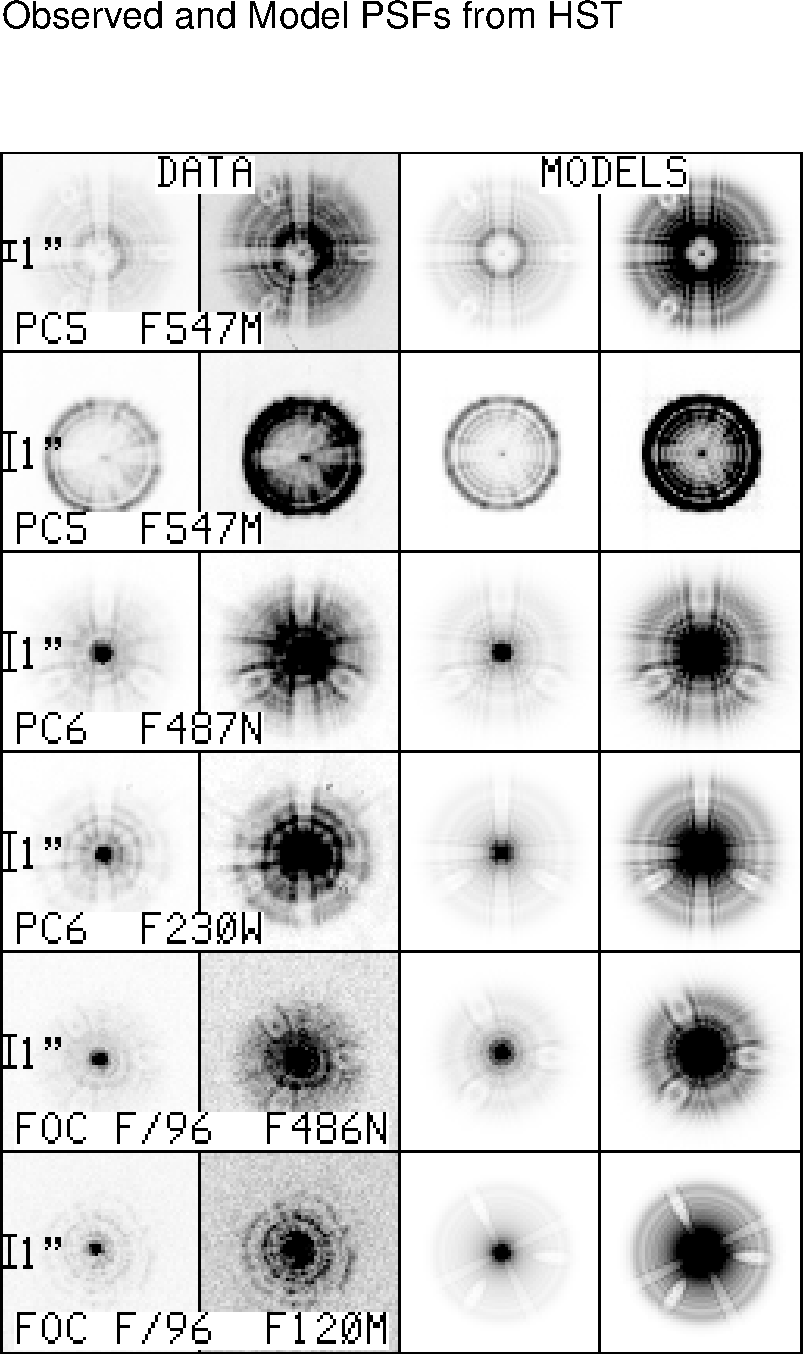
IMG/PSFFIG.PS203,776 bytes — “Observed and Model PSFs from HST” (PostScript, October 1990) - 1990-10-11
IMG/PSFFIG2.PS34,756 bytes - 1990-10-12
IMG/ABSTRACT.TXT1,417 bytes — Draft abstract on HST imaging performance (October 1990) - 1990-10-12
IMG/ENCIRC1.PRO550 bytes - 1990-10-12
IMG/PC6F230W2.HHD131,072 bytes - 1990-10-12
IMG/PC6F230W2.HHH4,455 bytes - 1990-10-15
IMG/PC6F487N2.HHD131,072 bytes - 1990-10-15
IMG/PC6F487N2.HHH4,455 bytes - 1990-10-15
IMG/READDATA.PRO948 bytes - 1990-10-24
IMG/F96F486N_M2_GCF.HHD1,049,088 bytes - 1990-10-24
IMG/F96F486N_M2_GCF.HHH6,075 bytes - 1990-10-24
IMG/SUMMARY.LIS646 bytes — FOC focus-monitoring data note (R. Jedrzejewski, October 1990) - 1990-10-25
IMG/NEWM10.HHD643,584 bytes - 1990-10-25
IMG/NEWM10.HHH891 bytes - 1990-10-25
IMG/OLDM10.HHD643,584 bytes - 1990-10-25
IMG/OLDM10.HHH891 bytes - 1990-11-13
IMG/P1.HHD786,432 bytes - 1990-11-13
IMG/P1.HHH1,215 bytes - 1990-11-13
IMG/P1A.HHH1,215 bytes - 1990-11-13
IMG/P2.HHH4,455 bytes - 1990-11-13
IMG/P2A.HHH4,455 bytes - 1990-11-14
IMG/P1A.HHD786,432 bytes - 1990-11-14
IMG/P2.HHD131,072 bytes - 1990-11-14
IMG/P2A.HHD131,072 bytes - 1990-12-03
IMG/COSMIC.PRO28 bytes - 1990-12-03
IMG/IMAGE1.DAT276 bytes - 1990-12-03
IMG/IMAGE1.HHD262,144 bytes - 1990-12-03
IMG/IMAGE1.HHH891 bytes - 1990-12-03
IMG/IMAGE1.LOG688 bytes — Fit log: focus and spherical (b11 = −0.5) for image 1 - 1990-12-03
IMG/IMAGE1.PRO700 bytes - 1990-12-03
IMG/IMAGE1SIM.HHD262,144 bytes - 1990-12-03
IMG/IMAGE1SIM.HHH891 bytes - 1990-12-03
IMG/IMAGE1SIM.PRO644 bytes - 1990-12-03
IMG/IMAGE2.DAT276 bytes - 1990-12-03
IMG/IMAGE2.HHD65,536 bytes - 1990-12-03
IMG/IMAGE2.HHH891 bytes - 1990-12-03
IMG/IMAGE2.LOG688 bytes - 1990-12-03
IMG/IMAGE2.PRO684 bytes - 1990-12-03
IMG/IMAGE2SIM.HHD65,536 bytes - 1990-12-03
IMG/IMAGE2SIM.HHH891 bytes - 1990-12-03
IMG/IMAGE2SIM.PRO643 bytes - 1990-12-03
IMG/IMAGE3.HHD65,536 bytes - 1990-12-03
IMG/IMAGE3.HHH891 bytes - 1990-12-03
IMG/IMAGE3.PRO2,704 bytes - 1990-12-03
IMG/IMAGE3SIM.PRO643 bytes - 1990-12-03
IMG/IMAGE4.DAT770 bytes - 1990-12-03
IMG/IMAGE4.HHD65,536 bytes - 1990-12-03
IMG/IMAGE4.HHH891 bytes - 1990-12-03
IMG/IMAGE4.LOG688 bytes - 1990-12-03
IMG/IMAGE4.PRO2,714 bytes - 1990-12-03
IMG/IMAGE4SIM.HHD65,536 bytes - 1990-12-03
IMG/IMAGE4SIM.HHH891 bytes - 1990-12-03
IMG/IMAGE4SIM.PRO643 bytes - 1990-12-03
IMG/IMAGE5.HHD262,144 bytes - 1990-12-03
IMG/IMAGE5.HHH891 bytes - 1990-12-03
IMG/IMAGE5SIM.HHD262,144 bytes - 1990-12-03
IMG/IMAGE5SIM.HHH891 bytes - 1990-12-03
IMG/IMAGE5SIM.PRO643 bytes - 1990-12-03
IMG/IMAGE6.DAT511 bytes - 1990-12-03
IMG/IMAGE6.HHD262,144 bytes - 1990-12-03
IMG/IMAGE6.HHH891 bytes - 1990-12-03
IMG/IMAGE6.PRO1,532 bytes - 1990-12-03
IMG/OIMAGE3.HHD262,144 bytes - 1990-12-03
IMG/OIMAGE3.HHH891 bytes - 1990-12-03
IMG/OIMAGE4.HHD262,144 bytes - 1990-12-03
IMG/OIMAGE4.HHH891 bytes - 1990-12-03
IMG/OIMAGE5.HHD643,584 bytes - 1990-12-03
IMG/OIMAGE5.HHH891 bytes - 1990-12-03
IMG/OIMAGE6.HHD643,584 bytes - 1990-12-03
IMG/OIMAGE6.HHH891 bytes - 1990-12-03
IMG/W0BM0601T.D0H20,480 bytes - 1990-12-03
IMG/W0BM0602T.D0H20,480 bytes - 1990-12-03
IMG/W0BM0603T.D0H20,480 bytes - 1990-12-03
IMG/W0BM0604T.D0H20,480 bytes - 1990-12-03
IMG/W0BM0605T.D0H20,480 bytes - 1990-12-03
IMG/W0BM0606T.D0H20,480 bytes - 1990-12-03
IMG/X0BK0602T.D0H13,120 bytes - 1990-12-03
IMG/X0BK0603T.D0H13,120 bytes - 1990-12-03
IMG/X0BK0604T.D0H13,120 bytes - 1990-12-03
IMG/X0BK0605T.D0H13,120 bytes - 1990-12-04
IMG/IMAGE5N.HHD262,144 bytes - 1990-12-04
IMG/IMAGE5N.HHH891 bytes - 1990-12-04
IMG/IMAGE5N.PRO1,532 bytes - 1990-12-04
IMG/IMAGE6.JKD160,000 bytes - 1990-12-04
IMG/IMAGE6.JKH891 bytes - 1990-12-04
IMG/IMAGE6.LOG688 bytes - 1990-12-04
IMG/IMAGE6SIM.COM47 bytes - 1990-12-04
IMG/IMAGE6SIM.HHD262,144 bytes - 1990-12-04
IMG/IMAGE6SIM.HHH891 bytes - 1990-12-04
IMG/IMAGE6SIM.PRO883 bytes - 1990-12-04
IMG/IMAGE6TEMP.JKD160,000 bytes - 1990-12-04
IMG/IMAGE6TEMP.JKH891 bytes - 1990-12-04
IMG/IMAGE6TEMPSIM.HHD171,396 bytes - 1990-12-04
IMG/IMAGE6TEMPSIM.HHH891 bytes - 1990-12-05
IMG/PLATE1.PRO300 bytes - 1990-12-07
IMG/PLATE1.JKD409,600 bytes - 1990-12-07
IMG/PLATE1.JKH891 bytes - 1990-12-07
IMG/PLATE1.PS835,584 bytes — Plate 1 (PostScript, 6 December 1990) - 1990-12-07
IMG/PLATE1R.HHD1,638,400 bytes - 1990-12-07
IMG/PLATE1R.HHH891 bytes - 1990-12-07
IMG/PLATE2.JKD393,216 bytes - 1990-12-07
IMG/PLATE2.JKH891 bytes - 1990-12-07
IMG/PLATE2.PRO6,488 bytes - 1990-12-07
IMG/PLATE2.PS802,304 bytes — Plate 2: data and models through focus, PC, FOC (PostScript, 6 December 1990) - 1990-12-07
IMG/PLATE2R.HHD1,572,864 bytes - 1990-12-07
IMG/PLATE2R.HHH891 bytes - 1990-12-11
IMG/SCALES.TXT243 bytes — Conversion of focal-plane shifts to wavefront error
Documents (5 files)
- 1990-06-07
ALIGN.TXT3,890 bytes — WF/PC alignment notes (June 1990) - 1990-06-07
VIG.TXT3,347 bytes — WF/PC vignetting notes (June 1990) - 1990-07-27
NEWSLETTER.TEX6,807 bytes — STScI Newsletter article “HST’s imaging performance” (July 1990): ~0.5 wave rms of spherical aberration - 1990-10-17
STRATEGY.DOC19,977 bytes — Input to the HST Strategy Panel (October 1990), Word for DOS; text extract alongside - 1990-10-17
STRATEGY_extracted.txt17,279 bytes — Plain-text extract of STRATEGY.DOC
Original exposures in the MAST archive (public) (9 files)
- 1990-05-20
w0340a02t_c0f.fits10,275,840 bytes — WFC, 1 s, NGC 3532: first-light exposure (proposal 1476); calibrated FITS - 1990-05-20
w0340a03t_c0f.fits10,275,840 bytes — WFC, 30 s, NGC 3532: first-light image (proposal 1476); calibrated FITS - 1990-06-13
w0b10105t_c0f.fits10,275,840 bytes — PC F547M 180 s, star near Iota Carinae, focus sweep (proposal 2979); calibrated FITS - 1990-06-19
w0b15105t_c0f.fits10,275,840 bytes — PC F547M 180 s, focus sweep (2979); calibrated FITS - 1990-06-21
w0b16105t_c0f.fits10,275,840 bytes — PC F547M 180 s, secondary moved 312 µm toward primary: far out of focus, pupil map (2979); calibrated FITS - 1990-06-23
w0b17105t_c0f.fits10,275,840 bytes — PC F547M 180 s, secondary moved away to the fine-lock limit: out of focus (2979); calibrated FITS - 1990-06-25
w0b18105t_c0f.fits10,275,840 bytes — PC F547M 180 s, focus sweep (2979); calibrated FITS - 1990-07-01
w0b19105t_c0f.fits10,275,840 bytes — PC F547M 180 s, star near HR 6241, focus sweep (2979); calibrated FITS - 1990-08-15
w0bm0605t_c0f.fits10,275,840 bytes — PC F487N 3 s, HD 124063, fine focus run (proposal 3029); calibrated FITS
Raw (uncalibrated) exposures in the MAST archive (11 files)
- 1990-05-12
w0340y02r_d0f.fits5,155,200 bytes — WFC 0.3 s, NGC 3532, early test frame (1476); raw counts, no bias or flat correction (companion data-quality, overscan and header files: _q0f, _x0f, _shf) - 1990-05-12
w0340y03r_d0f.fits5,155,200 bytes — WFC 0.3 s, NGC 3532 (1476); raw counts, no bias or flat correction (companion data-quality, overscan and header files: _q0f, _x0f, _shf) - 1990-05-20
w0340a02t_d0f.fits5,155,200 bytes — WFC 1 s, first light (1476); raw counts, no bias or flat correction (companion data-quality, overscan and header files: _q0f, _x0f, _shf) - 1990-05-20
w0340a03t_d0f.fits5,155,200 bytes — WFC 30 s, first light (1476); raw counts, no bias or flat correction (companion data-quality, overscan and header files: _q0f, _x0f, _shf) - 1990-06-13
w0b10105t_d0f.fits5,155,200 bytes — PC F547M 180 s, focus sweep (2979); raw counts, no bias or flat correction (companion data-quality, overscan and header files: _q0f, _x0f, _shf) - 1990-06-19
w0b15105t_d0f.fits5,155,200 bytes — PC F547M 180 s (2979); raw counts, no bias or flat correction (companion data-quality, overscan and header files: _q0f, _x0f, _shf) - 1990-06-21
w0b16105t_d0f.fits5,155,200 bytes — PC F547M 180 s, secondary −312 µm, pupil image (2979); raw counts, no bias or flat correction (companion data-quality, overscan and header files: _q0f, _x0f, _shf) - 1990-06-23
w0b17105t_d0f.fits5,155,200 bytes — PC F547M 180 s, secondary moved away (2979); raw counts, no bias or flat correction (companion data-quality, overscan and header files: _q0f, _x0f, _shf) - 1990-06-25
w0b18105t_d0f.fits5,155,200 bytes — PC F547M 180 s (2979); raw counts, no bias or flat correction (companion data-quality, overscan and header files: _q0f, _x0f, _shf) - 1990-07-01
w0b19105t_d0f.fits5,155,200 bytes — PC F547M 180 s (2979); raw counts, no bias or flat correction (companion data-quality, overscan and header files: _q0f, _x0f, _shf) - 1990-08-15
w0bm0605t_d0f.fits5,155,200 bytes — PC F487N 3 s, fine focus (3029); raw counts, no bias or flat correction (companion data-quality, overscan and header files: _q0f, _x0f, _shf)
Record of the discovery
- Eric J. Chaisson, The Hubble Wars (HarperCollins, 1994), pp. 190–196, 205, 221. Chaisson, then STScI’s director of public affairs, records that on 30 May 1990, ten days after first light, Chris showed him a nineteen-page memorandum with a thorough numerical analysis of the WF/PC first-light images making the case for spherical aberration, and that it was then sent to NASA. He calls Chris the person “who had originally identified the problem” (p. 205) and “who had uncovered the mirror’s flaw” (p. 221), and records that a week later the contractor’s own analysis still found negligible spherical aberration. Source →
- Minutes of the HST Performance Monitoring and Assessment meeting #5, Goddard, 5 June 1990. Contemporary record of the contractor’s position: Hughes Danbury’s phase retrieval on a 3 June Planetary Camera image gave spherical aberration of only ~0.2 wave peak-to-valley and ~4 waves of coma, blamed on secondary-mirror misalignment. This was six days after Chris’s memorandum. Excerpt in the Archive. Source →
- Chris’s IDL code, May–June 1990 (STScI files). The surviving fitting programs carry their original dates: a simplex optimiser and a PSF-fitting driver of 22–25 May 1990, two to five days after first light; a routine of 30 May converting the fitted coefficients, including a spherical-aberration term, to normalised aberrations; and a plotting script of 31 May holding the fitted coefficient sets. The dates match the memorandum of 30 May.
- NASA, The Hubble Space Telescope Optical Systems Failure Report (Allen Report), November 1990. States that computer simulation of the first-light images indicated 0.5 wave rms of spherical aberration at 547 nm in the telescope and not in the instruments: the value from Chris’s analysis, which the report does not attribute to anyone by name. Source →
- Burrows, Holtzman, Faber, Bely, Hasan, Lynds and Schroeder, ApJ 369, L21 (1991). The first refereed account of the aberration and its effect on imaging performance, with Chris as first author. The author list records how those involved allocated credit at the time: WF/PC team members who worked on the problem, including Sandra Faber, Jon Holtzman and Roger Lynds, appear as co-authors. Source →
- Krist and Burrows, Applied Optics 34, 4951 (1995). Phase-retrieval analysis of the pre- and post-repair images, including the aberrated first-generation cameras and the out-of-focus images Chris planned to confirm the spherical aberration. Gives the primary-mirror conic constant as −1.0144. Source →
- Robert A. Brown, NASA Hubble oral history (2016). Brown, co-chair of the HST Strategy Panel, says Chris was the first to know the problem was spherical aberration, and credits his diagnosis as the basis for the confidence in COSTAR. Source →
- Ray Villard, NASA Hubble oral history (2015). STScI’s news director recalls Chris recognising spherical aberration in the first released image and warning him the day before NASA’s announcement. Source →
- NASA press conference, 27 June 1990. NASA’s archival video is a shortened edit showing the first panel. Chris sat on the second, technical panel; the full recording has been requested from NASA. Source →
- Chris Burrows, oral history with Chris Gainor (2017). Chris’s own account of the fitting procedure, the Goddard meetings and the month of resistance; drawn on in Gainor’s NASA history Not Yet Imagined (2020).
- Other accounts. The WF/PC team’s recollections (Westphal’s 1998 Caltech oral history; Astronomy, June 2020) credit Roger Lynds with remarking on first-light day that the images looked spherically aberrated. Chris recalls that when he met Lynds at the WF/PC team’s facility at Bowie State, Lynds told him he did not know what it was. Lynds is a co-author of the 1991 paper, on which Chris is first author. The distinction the record supports is between a qualitative impression and the quantitative diagnosis: Chris’s phase-retrieval fit, the half-wave value, the memorandum of 30 May, and the defocus test he designed to confirm it.
From the archive
Papers
- 1991
- 1995Phase-retrieval analysis of pre- and post-repair Hubble Space Telescope imagesKrist, J. E.; Burrows, C. J.Applied Optics 34(22), 4951
- 1990